A plain-language log of what we've shipped to the PANDA platform. Each entry links straight into the feature so you can try it.
Endoscopy overlay legend
One colour language for annotations and the assessment panel
The Endoscopy session now uses a single semantic colour scheme for everything drawn on the image and for the tissue-classification bars, with a legend in the assessment panel.
Colours mean something, not labels
Orange marks cancer risk (potential cancer, lesion), green a cyst, blue the pancreas and surrounding structures, grey needles and artifacts. Red is reserved for confirmed cancer. The same scheme drives the burned-in annotations on the demo cases and the probability bars on the left.
The demo catalog now carries four physician-reviewed, annotated EUS cases (adenocarcinoma, metastatic adenocarcinoma, mixed-type IPMN and a benign control), streamed as pre-packaged HLS so playback starts without buffering.
Molecular markers
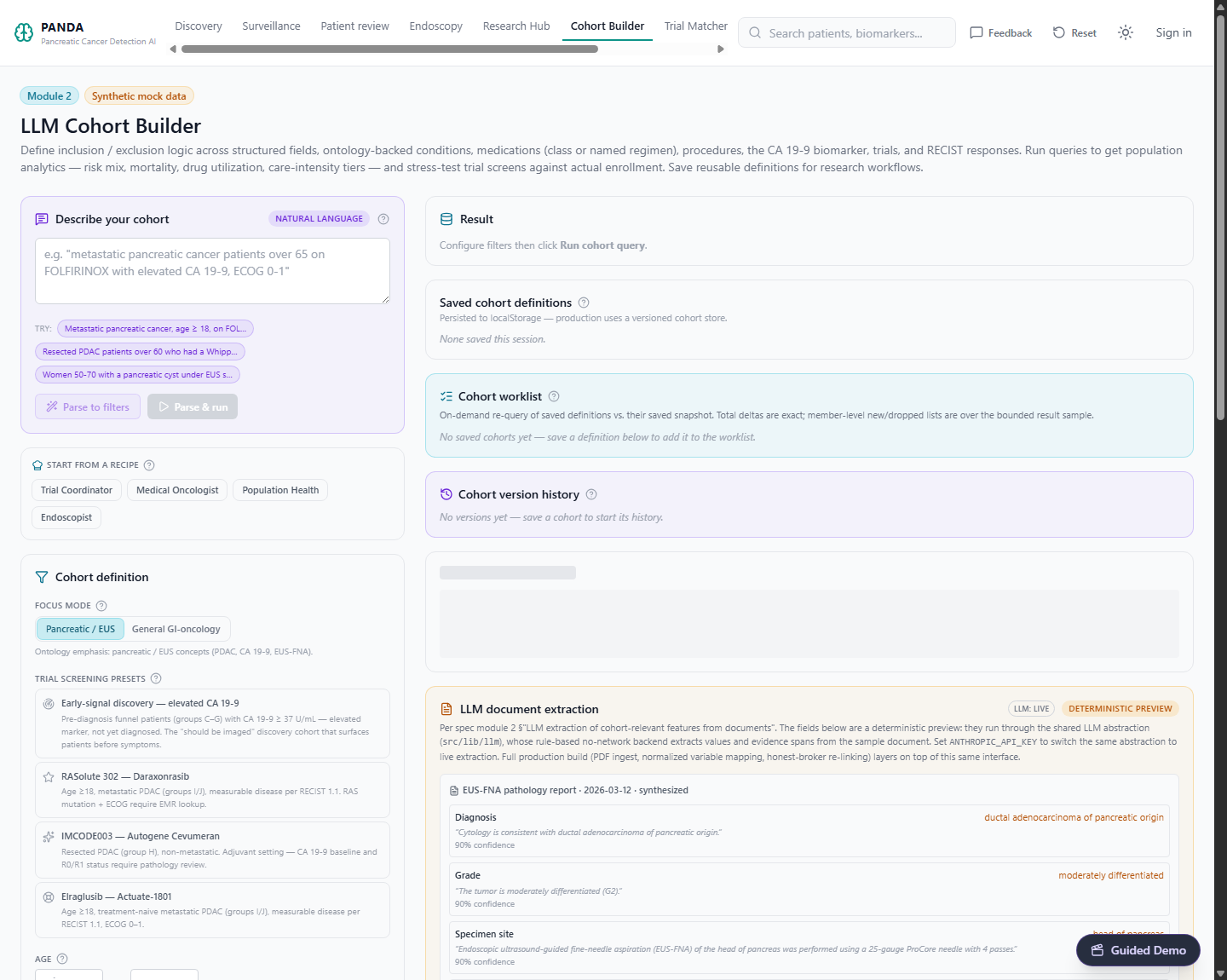
Build cohorts on molecular markers
The Cohort Builder now understands molecular / genomic results — not just numeric labs — and there's a reusable way to load a site's own marker panels.
KRAS, BRCA1/2, HER2 and MSI as cohort filters
Alongside the numeric markers (CA 19-9, CEA, bilirubin), you can now require an actionable molecular result — “KRAS mutation detected,” “BRCA2 pathogenic variant,” “MSI-High” — and combine them with any other criteria. Matched patients show the exact result in their evidence.
Any lab-style results export (patient, marker, value, date) loads through one reusable, idempotent import — a site’s local codes are mapped to the catalog, so new markers are a load, not a rebuild.
Summer 2026
Ask anything, and never lose a patient
This release turns the Cohort Builder into a conversation and adds the surveillance and documentation workflows our clinical advisors told us matter most in pancreatic care.
The Cohort Builder — describe a population in plain English, then dig in with follow-up questions.
Ask anything about a cohort
After a cohort runs, a follow-up box answers open-ended questions in plain language — “what’s different about the patients with diabetes?”, “how many are treatment-naive?” — and keeps the thread going so you can keep digging without starting over.
Click any segment of the analytics — a risk group, a comorbidity, a treatment — and PANDA builds that sub-group and instantly compares it to the parent cohort, so the differences that matter surface on their own.
Survival, explained
The survival curve now comes with a written read-out: which subgroup is driving the outcome and the plausible levers that could improve it — written for a population-health or tumor-board audience, not a statistician.
Cyst surveillance recall worklist
Pancreatic cysts get lost to follow-up. This worklist flags who is due, scores the concern, recommends a 3- or 6-month interval, and drafts the patient recall note — so the “come back and get re-checked” message actually goes out.
Decision & liability documentation
A one-click, audit-ready record of a clinical decision and the evidence behind it, per patient or per cohort — the artifact that protects clinicians when a diagnosis is later questioned.
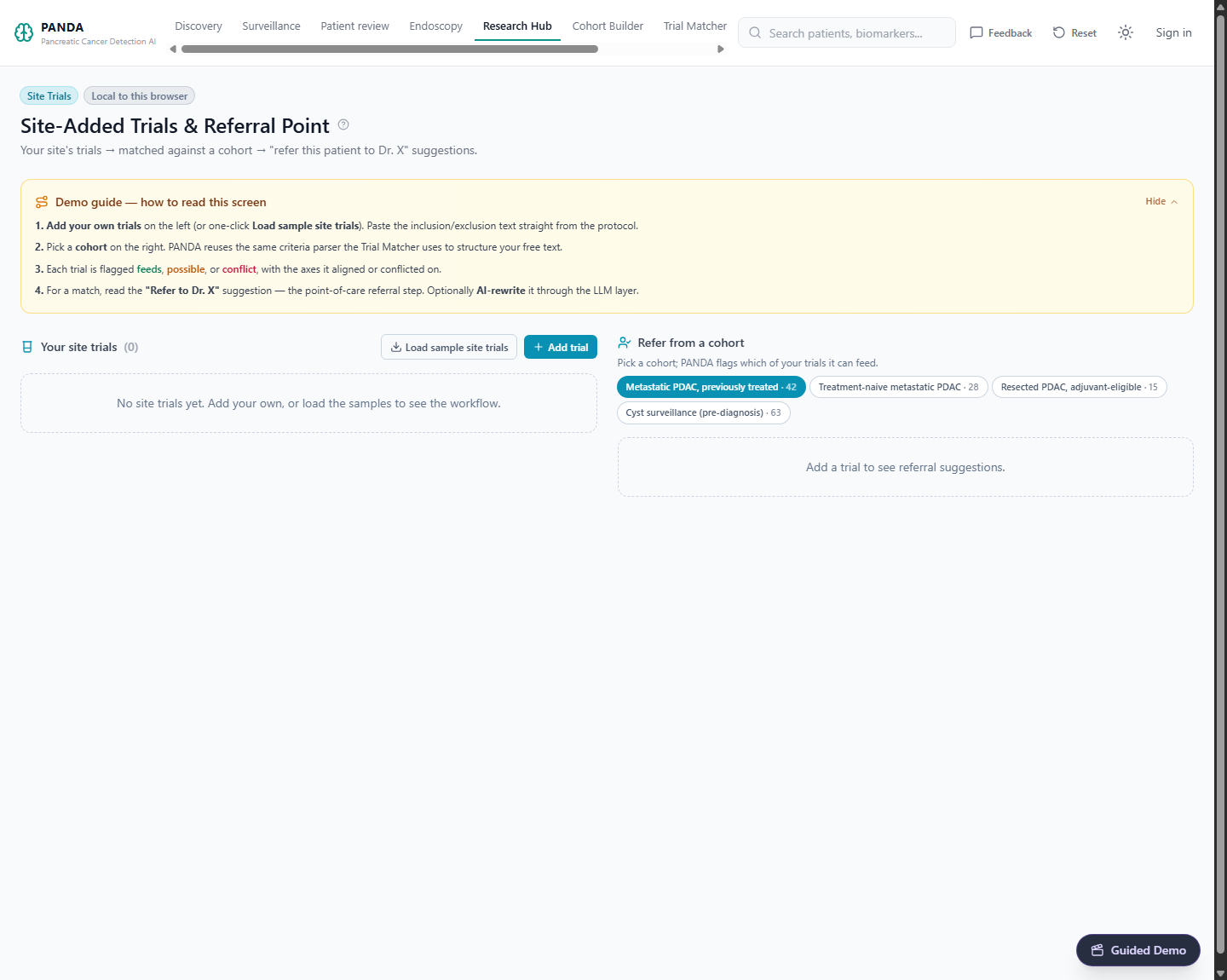
Site trials
Match patients to the trials you actually run
Instead of the whole public trials universe, load the studies your site owns and match your patients against them — then hand the patient off to the right investigator.
Load your own studies and screen your population against them.
Bring your own trials
Enter a study’s title, sponsor, and inclusion/exclusion criteria and PANDA screens your patients against it — focused on the trials your site can actually enroll into.
A wave of upgrades made the Cohort Builder understand how clinicians actually describe patients, and turned each result into a briefing rather than a raw count.
Plain-language, synonym-aware search
Describe a population the way you’d say it out loud. PANDA understands clinical synonyms and abbreviations across diagnoses, medications, procedures, and labs — so “Whipple,” “pancreaticoduodenectomy,” and the procedure code all find the same patients.
Build cohorts directly on the CA 19-9 tumor marker — elevated, normal, or a threshold you set — alongside stage, risk group, treatment, and RECIST response.
Instant population read-out
Every cohort now returns a briefing: risk mix, mortality, drug utilization, care-intensity tiers, comorbidities, and treatment sequences — with a confidence indicator on how well the query matched.
Trial-screening stress test
Point a trial’s screening criteria at your real population to see, before you commit, how many patients would actually pass — and why the rest fall out.